Preparedness in Practice - How SEYPEC strengthened emergency response by bringing together key agencies to test plans, build partnerships and enhance public safety
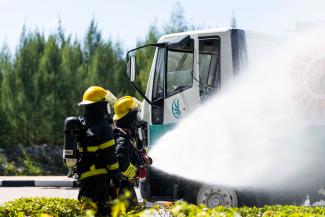
A fuel bowser caught fire on a public road. The driver pulled over safely and raised the alarm. Within minutes, emergency responders arrived, traffic was managed, the scene was secured and the incident was brought under control.
Fortunately, it was not a real emergency.
It was a carefully planned exercise organised by SEYPEC to test how people, procedures and partnerships come together when every second counts.
On Thursday, 23 July, SEYPEC led a multi-agency emergency response drill on Praslin, bringing together the Seychelles Fire and Rescue Services Agency (SFRSA), the Seychelles Police Force, the Disaster Risk Management Division (DRMD) and other key stakeholders.
While the scenario was simulated, the objective was real: to ensure that emergency plans remained effective, response teams stayed prepared and agencies continued to work seamlessly together.
Emergency preparedness does not begin when an incident occurs. It starts long before, with planning, training and the regular testing of response procedures.
As Seychelles' national petroleum company, SEYPEC has a responsibility that extends beyond ensuring a reliable supply of fuel. It also has a duty to safeguard its employees, protect surrounding communities and minimise risks to the environment. Regular emergency response exercises form an important part of meeting that responsibility.
SEYPEC Chief Executive Officer, Captain Adrian Mondon, said the exercise reflected the company's commitment to maintaining the highest standards of safety through preparation and collaboration.
"As the national petroleum company, safety is at the heart of everything we do. This exercise provided an opportunity to test our systems, strengthen our coordination with emergency response agencies and ensure that our people are ready to respond effectively should an incident ever occur.
Preparedness is not something you improvise in a crisis. It’s built through planning, training and collaboration. By investing in exercises like this, we are not only protecting our employees and our operations, but also the communities we serve and the environment we all share."
The drill was months in the making. Ahead of the exercise, representatives from the participating organisations met to review the response plan, clarify their respective roles and ensure every aspect of the operation had been carefully coordinated.
Throughout the exercise, participants tested several key areas, including initial responses, communication procedures, incident management and coordination between emergency services. The simulation also provided an opportunity to identify areas for improvement and strengthen existing emergency response arrangements.
No emergency unfolds exactly as expected. That is why realistic exercises remain an essential part of emergency preparedness. They allow organisations to evaluate their procedures in a controlled environment, strengthen coordination between agencies and build the confidence needed to respond effectively when faced with real-life situations.
Preparedness is not the responsibility of one organisation alone. Effective emergency response depends on strong partnerships, clear communication and a shared commitment to protecting lives, property and the environment.
By taking the initiative to organise the exercise, SEYPEC reinforced that commitment. The drill was not simply about responding to a simulated incident; it was about investing in resilience, strengthening collaboration and ensuring that, should an emergency ever arise, the people and organisations responsible for responding would be ready.
For SEYPEC, the success of the exercise is measured not by the realism of the scenario, but by the strength of the partnerships it reinforced and the confidence it built among everyone involved. It served as a reminder that when it comes to protecting people, communities and the environment, preparedness is always the first line of defence.